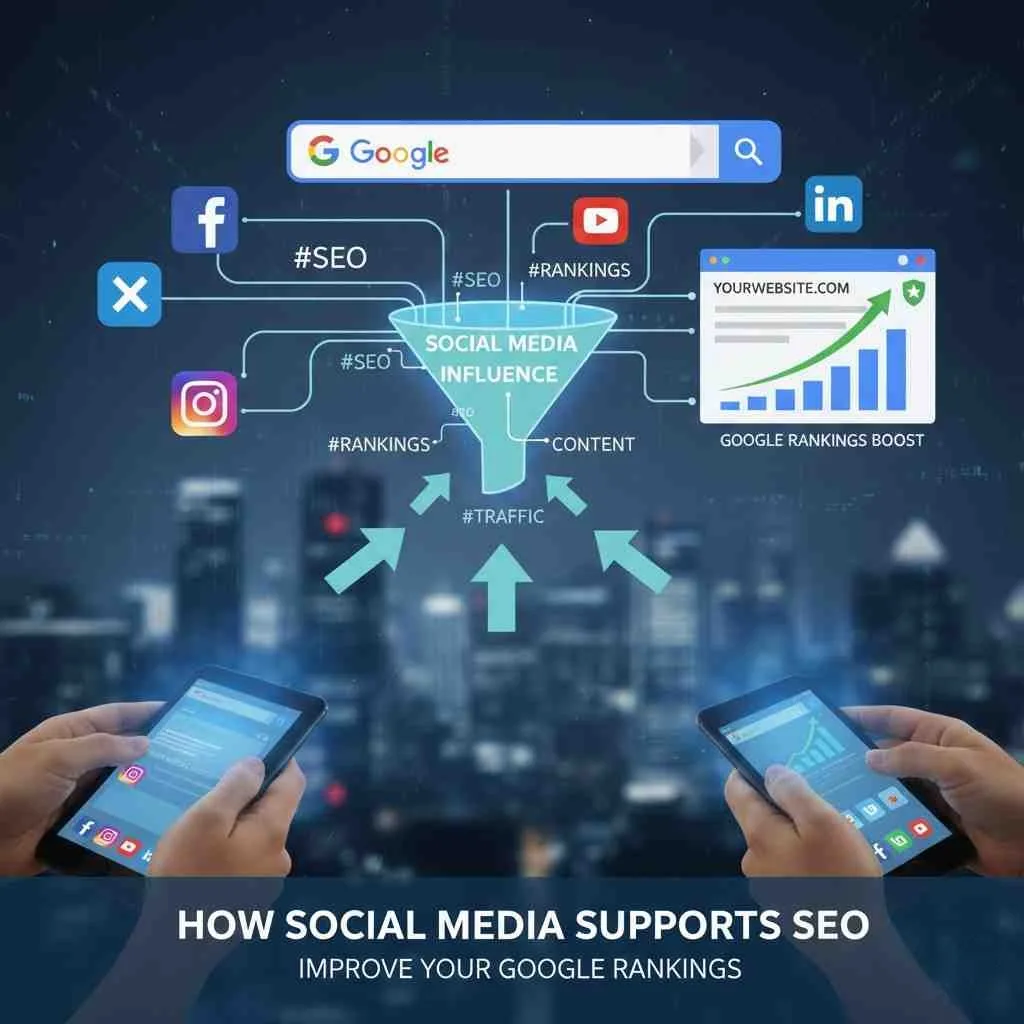
How Social Media Supports SEO and Improves Google Rankings
There’s a common misconception in the digital marketing world that social media and SEO operate in completely separate silos. Many business owners invest in one or the other, never realizing the powerful synergy that exists between these two channels. As an SEO strategist in Thrissur, I’ve witnessed firsthand how businesses that strategically integrate social media marketing with their SEO strategy achieve dramatically better Google rankings and organic traffic than those that treat them as isolated efforts. When you choose me to manage your digital presence, you’re getting someone who understands how to leverage social media platforms to amplify your SEO performance, build brand authority, and create a comprehensive online ecosystem that drives sustainable growth.
Let me show you exactly how social media supports SEO, the indirect ranking factors at play, and how you can harness this relationship to dominate search results in your industry.
Understanding the Social Media and SEO Connection
First, let’s address the elephant in the room: social media signals are not direct ranking factors in Google’s algorithm. Google has consistently stated that likes, shares, tweets, and followers don’t directly influence where your website ranks in search results. However, this doesn’t mean social media has no impact on SEO—quite the opposite.
The relationship between social media and SEO is indirect but incredibly powerful. Think of social media as the catalyst that triggers multiple SEO benefits: increased brand visibility, more backlinks, higher website traffic, improved brand searches, enhanced content distribution, and stronger user engagement signals. Each of these factors contributes to better search engine rankings over time.
When you create valuable content and promote it through social media platforms like Facebook, Instagram, LinkedIn, Twitter, and YouTube, you’re setting off a chain reaction that ultimately benefits your SEO performance. Let’s break down exactly how this works.
How Social Media Amplifies Content Reach and Visibility
One of the most significant ways social media supports SEO is through content amplification. When you publish a blog post, video, infographic, or any content asset on your website, social media becomes the megaphone that ensures people actually see it.
Here’s the sequence: You create high-quality SEO-optimized content targeting specific keywords. You share it across your social media channels. Your followers engage with it, share it with their networks, and discussion forms around your content. This increased visibility leads to more people visiting your website, spending time consuming your content, and potentially linking to it from their own websites or blogs.
Search engines like Google pay attention to user engagement signals—how long people stay on your page, whether they click through to other pages, and if they return to your site. When social media drives engaged, interested visitors to your content, these positive engagement metrics signal to Google that your content is valuable and deserves higher rankings.
For businesses in Thrissur, this is particularly powerful for local SEO. When you share content about local events, community involvement, or location-specific services on social media, you’re reaching people in your geographic area who are most likely to search for your services on Google. This local engagement builds relevance signals that support your local search rankings.
The beauty of social media amplification is that it creates compound effects. When your content gets shared widely on platforms like Facebook or LinkedIn, it reaches audiences far beyond your immediate followers. Each share exposes your brand to new potential customers, some of whom may become regular visitors to your website, subscribe to your newsletter, or even become brand advocates who promote your business through their own social media channels and websites.
Social Media Drives Quality Backlinks
Backlinks remain one of the most important ranking factors for SEO. When authoritative websites link to your content, it signals to search engines that your website is trustworthy and valuable. Social media plays a crucial role in earning these quality backlinks.
When you share compelling content on social media platforms, you increase the chances that bloggers, journalists, industry influencers, and website owners will discover it. If they find your content valuable, they may reference it in their own articles, blog posts, or resources—creating natural backlinks to your website.
This is especially effective with data-driven content, original research, comprehensive guides, and visually engaging infographics. For example, if you publish a detailed market analysis relevant to Kerala’s business landscape and promote it through LinkedIn and Twitter, industry publications and business blogs are more likely to discover and cite your research, earning you authoritative backlinks that boost your domain authority and search rankings.
The key is consistency and quality. Regularly sharing valuable content on social media keeps you visible to potential linkers. Over time, you build a reputation as a trusted source of information in your industry, making it more likely that people will naturally link to your content without you even asking.
Content that performs exceptionally well on social media—garnering hundreds or thousands of shares, comments, and engagement—signals to the broader internet community that it’s worth paying attention to. Industry bloggers and content curators actively monitor social media for trending topics and viral content. When your content catches fire on social platforms, it’s far more likely to be discovered by these influential voices who can provide the high-authority backlinks that significantly impact SEO performance.
Social Profiles Rank in Search Results
Here’s something many business owners overlook: social media profiles themselves often rank in Google search results. When someone searches for your brand name or your business, your Facebook page, LinkedIn profile, Instagram account, or YouTube channel frequently appear on the first page of results.
This creates multiple touchpoints with potential customers. Instead of just seeing your website, they see a comprehensive brand presence across multiple platforms. This multi-channel visibility builds trust and credibility—important factors in converting searchers into customers.
Moreover, well-optimized social media profiles can rank for industry-related keywords too. A YouTube video tutorial can rank for how-to queries. A LinkedIn article can appear in search results for professional topics. Pinterest pins can rank for visual searches. By optimizing your social media content with relevant keywords, descriptions, and hashtags, you create additional pathways for people to discover your brand through search engines.
For local businesses in Thrissur, this means ensuring your social media profiles include complete location information, local keywords, and content that resonates with your geographic audience. When someone searches “best wedding photographer Thrissur” or “digital marketing services Kerala,” your optimized social media presence can appear alongside traditional website results.
Think of your social media profiles as additional real estate in Google search results. While you can typically only have one organic listing for your main website, you can potentially occupy multiple positions on page one when your Facebook page, LinkedIn company page, YouTube channel, and Twitter profile all appear. This domination of the SERP (Search Engine Results Page) crowds out competitors and gives potential customers multiple entry points to learn about your business.
Social Media Builds Brand Authority and Search Demand
Brand authority significantly impacts SEO performance, and social media is one of the most effective tools for building it. When you consistently share expert insights, engage with your audience, provide customer support, and demonstrate thought leadership on social media platforms, you establish your brand as an authority in your field.
This authority translates to SEO benefits in several ways. First, people who recognize your brand from social media are more likely to click on your website in search results over unknown competitors—improving your click-through rate, which is a ranking signal. Second, brand familiarity increases the likelihood that people will search for your brand directly, and branded searches are extremely valuable for SEO.
Google interprets increasing branded search volume as a signal of brand strength and relevance. When more people specifically search for your business name, products, or services, Google understands that your brand has market demand and authority, which can positively influence your rankings for non-branded keywords as well.
Social media also allows you to showcase social proof—customer testimonials, reviews, case studies, and user-generated content. This social proof builds trust, and trust is a critical component of Google’s E-E-A-T (Experience, Expertise, Authoritativeness, Trustworthiness) framework that influences search rankings, particularly for industries like healthcare, finance, and professional services.
Building brand authority through social media creates a halo effect that benefits all your SEO efforts. When people recognize your brand as a trusted voice in your industry, they’re more likely to engage with your content, share it with others, link to it from their websites, and recommend your business. All of these behaviors contribute to stronger SEO performance over time.
Increased Website Traffic from Social Channels
While traffic from social media doesn’t directly improve rankings, the behaviors of that traffic certainly do. When social media drives visitors to your website who genuinely engage with your content—reading articles, watching videos, downloading resources, filling out forms—it sends positive signals to search engines.
Google Analytics and other tracking tools show search engines how users interact with your site. Metrics like time on page, pages per session, and bounce rate all contribute to understanding content quality. High-quality social media traffic that engages deeply with your content improves these engagement metrics, indirectly supporting better SEO performance.
Furthermore, visitors who discover your brand through social media might return later via organic search. This pattern of repeat visits strengthens your site’s authority and relevance in Google’s eyes. Over time, a portion of your social media audience will transition to searching for you directly or finding you through search engines for related topics.
For content marketing, this creates a virtuous cycle: create valuable content, promote it on social media, drive engaged traffic, improve engagement signals, achieve better rankings, attract more organic traffic, share new content with your growing audience, and repeat. This cycle compounds over time, with each iteration strengthening your overall digital presence.
The quality of social media traffic matters more than quantity. Ten highly engaged visitors who spend several minutes reading your content, explore multiple pages, and bookmark your site for later are far more valuable for SEO than a hundred visitors who bounce immediately. This is why targeted social media marketing that reaches the right audience is crucial—it’s not about going viral, it’s about attracting genuinely interested people who will engage meaningfully with your brand.
Social Media Accelerates Content Indexing
When you publish new content on your website, it can take time for search engines to discover, crawl, and index it. social media can accelerate this process significantly. When you share a new blog post or webpage on social media platforms immediately after publishing, the signals generated—clicks, shares, engagement—alert search engines that fresh content exists.
Google’s crawlers monitor social media activity and follow links shared on these platforms. When your content gets immediate traction on social media, Google is more likely to prioritize crawling and indexing it quickly. This is particularly valuable for time-sensitive content like news, trending topics, or limited-time offers where rapid indexing matters.
Additionally, social media helps with content distribution to niche communities. Sharing your content in relevant Facebook groups, LinkedIn communities, or Reddit threads puts it in front of highly targeted audiences who are more likely to engage and share, creating broader distribution networks that support SEO through increased visibility and potential backlink opportunities.
The speed at which your content spreads on social media can also indicate to Google that it’s particularly valuable or newsworthy. When a piece of content gains rapid traction—accumulating shares, comments, and engagement within hours of publication—it signals relevance and timeliness, qualities that search engines value highly.
Platform-Specific Strategies for SEO Benefits
Different social media platforms offer unique opportunities to support your SEO efforts:
YouTube is the second-largest search engine after Google and is owned by Google. Video content on YouTube can rank in both YouTube and Google search results. Optimizing videos with keyword-rich titles, descriptions, tags, and transcripts creates powerful SEO assets. Videos also appear in Google’s video carousel, giving you additional SERP real estate.
LinkedIn is excellent for B2B businesses and professional services. Publishing long-form articles on LinkedIn with proper keyword optimization can rank in Google for professional topics. LinkedIn profiles also rank well for personal brand searches, supporting personal SEO for entrepreneurs and executives.
Instagram and Pinterest drive visual discovery. While these platforms are less directly connected to traditional SEO, they support brand awareness and can drive significant referral traffic. Pinterest pins particularly can rank in Google image searches, creating another discovery channel.
Facebook offers local business features that support local SEO. A complete, optimized Facebook Business Page with regular posts, reviews, and local information strengthens your overall online presence and can appear in local search results.
Twitter (X) facilitates real-time engagement and content distribution. Tweets can appear in Google search results, especially for trending topics and breaking news. Twitter also serves as a relationship-building platform where you can connect with influencers and media who might link to your content.
Each platform requires a tailored approach. Understanding the unique characteristics, user behaviors, and SEO opportunities of each social media platform allows you to maximize the SEO benefits of your social media marketing efforts.
Measuring the Impact and Taking Strategic Action
To understand how social media supports your SEO efforts, track metrics like referral traffic from social media to your website in Google Analytics, engagement metrics (time on page, bounce rate) for social media traffic compared to other sources, branded search volume increases correlated with social media campaigns, backlinks earned from content promoted on social media, and social media profiles ranking for brand and industry keywords.
This is where working with an SEO strategist in Thrissur who understands integrated digital marketing becomes invaluable. Why choose me? Because I don’t treat SEO and social media as separate disciplines. I develop holistic strategies where social media marketing amplifies your SEO performance, where content serves both channels effectively, and where every piece of the digital puzzle works together to drive measurable business results. I analyze the data, identify opportunities, and create coordinated campaigns that maximize your return on investment across all digital channels.
The key to success is strategic integration. Create a content calendar that aligns your social media posts with your SEO content strategy. Optimize your social media profiles with relevant keywords and complete business information. Engage actively with your audience to build relationships and encourage sharing. Use social media insights to inform your content strategy, and make it easy for people to share your content through social sharing buttons and shareable assets.
In Thrissur’s competitive digital landscape, businesses that integrate social media with their SEO strategy gain significant advantages. They build broader brand awareness, create more pathways for customer discovery, and develop resilient digital ecosystems that don’t rely on a single traffic source. The synergy between social media and SEO creates compound growth that neither channel could achieve in isolation. Let’s discuss how strategic integration of social media and SEO can transform your digital presence and drive sustainable growth for your business.